Search Premiere Landscape, Inc. for a plant

Dave's Garden PlantFiles search engine

Find your plant by searching PlantFiles:
-

Premiere Landscape, Inc.

Saturday, May 28, 2011

Abutilon x hybridum


Abutilon x hybridum

Pink Flowering Maple


Pink Flowering Maple
Abutilon x hybridum


Family: Malvaceae (mal-VAY-see-ee)

Genus: Abutilon (a-BEW-tih-lon)

Species: x hybridum (hy-BRID-um)

Synonym: Abutilon globosum


Handsome, mounding shrub displays showy, drooping, soft pink blooms throughout the year. Graceful stems form a natural espalier. Can be trained into a patio tree. Good in containers. Evergreen.


Botanical Pronunciation: a-BEW-ti-lon HIB-ri-dum

Key feature: Attracts Hummingbirds

Plant type: Shrub

Garden style: Tropical Deciduous/evergreen: Evergreen

Cold hardiness zones: 9 - 11

Light needs: Partial to full sun Sunset

climate zones: 8, 9, 12 - 24

Water Needs: Needs regular watering - weekly, or more often in extreme heat.

Average landscape size: 8 to 12 ft. tall and wide.

Growth rate: Fast

Flower attribute: Showy Flowers
Special feature: Attracts Hummingbirds

Landscape uses: Border, Container, Espalier, Houseplant, Specimen

Flower color: Pink

Blooms: Spring through summer


Foliage color: Green


Care Information: Follow a regular watering schedule during the first growing season to establish a deep, extensive root system.

Feed with a general purpose
fertilizer before new growth begins in spring.

For a tidy, neat appearance,
shear annually to shape.

Pruning time: early spring.


Category: Shrubs Tropicals and Tender Perennials

Height: 18-24 in. (45-60 cm) 24-36 in. (60-90 cm) 36-48 in. (90-120 cm) 4-6 ft. (1.2-1.8 m) 6-8 ft. (1.8-2.4 m) 8-10 ft. (2.4-3 m) 10-12 ft. (3-3.6 m)

Spacing: 4-6 ft. (1.2-1.8 m) 6-8 ft. (1.8-2.4 m) 8-10 ft. (2.4-3 m)

Hardiness: USDA Zone 10a: to -1.1 °C (30 °F)
USDA Zone 10b: to 1.7 °C (35 °F)

USDA Zone 11: above 4.5 °C (40 °F)

Sun Exposure: Full Sun Sun to Partial Shade

Danger:
Parts of plant are poisonous if ingested


Bloom Color: Pale Pink Red Pale Yellow White/Near White

Bloom Time: Blooms all year Blooms repeatedly

Foliage: Evergreen Velvet/SmoothTextured

Other details: This plant is suitable for growing indoors

Average Water Needs; Water regularly; do not overwater

Soil pH requirements: 5.6 to 6.0 (acidic) 6.1 to 6.5 (mildly acidic)

Patent Information:
Non-patented Propagation

Methods:
From herbaceous stem cuttings
From softwood cuttings
From seed; sow indoors before last frost

Hydrangea arborescens 'Invincibelle Spirit'

Hydrangea arborescens 'Invincibelle Spirit'


Family: Hydrangeaceae (hy-drain-jee-AY-see-ee)
Genus: Hydrangea (hy-DRAIN-juh)
Species: arborescens (ar-bo-RES-senz)
Cultivar: Invincibelle Spirit


Height:
36-48 in. (90-120 cm)

Spacing:
36-48 in. (90-120 cm)

Hardiness:
USDA Zone 3a: to -39.9 °C (-40 °F)
USDA Zone 3b: to -37.2 °C (-35 °F)
USDA Zone 4a: to -34.4 °C (-30 °F)
USDA Zone 4b: to -31.6 °C (-25 °F)
USDA Zone 5a: to -28.8 °C (-20 °F)
USDA Zone 5b: to -26.1 °C (-15 °F)
USDA Zone 6a: to -23.3 °C (-10 °F)
USDA Zone 6b: to -20.5 °C (-5 °F)
USDA Zone 7a: to -17.7 °C (0 °F)
USDA Zone 7b: to -14.9 °C (5 °F)
USDA Zone 8a: to -12.2 °C (10 °F)
USDA Zone 8b: to -9.4 °C (15 °F)
USDA Zone 9a: to -6.6 °C (20 °F)
USDA Zone 9b: to -3.8 °C (25 °F)

Sun Exposure:
Full Sun
Sun to Partial Shade

Danger:
Parts of plant are poisonous if ingested

Bloom Color:
Pink
Rose/Mauve
Fuchsia (Red-Purple)

Bloom Time:
Mid Summer
Late Summer/Early Fall
Mid Fall
Late Fall/Early Winter

Foliage:
Deciduous

Other details:
Requires consistently moist soil; do not let dry out between waterings
Flowers are good for drying and preserving

Soil pH requirements:
6.1 to 6.5 (mildly acidic)
6.6 to 7.5 (neutral)
7.6 to 7.8 (mildly alkaline)

Patent Information:
Non-patented

Propagation Methods:
From herbaceous stem cuttings

Seed Collecting:
N/A: plant does not set seed, flowers are sterile, or plants will not come true from seed

Saturday, September 11, 2010

Clerodendrum trichotomum


Clerodendrum trichotomum

Family: Verbenaceae (ver-be-NAY-see-ee)
Genus: Clerodendrum (kler-oh-DEN-drum)
Species: trichotomum (try-KOH-toh-mum)

Synonym:Clerodendron trichotomum
Synonym:Siphonanthus trichotomum


Category:
Shrubs
Trees

Height:
15-20 ft. (4.7-6 m)

Spacing:
15-20 ft. (4.7-6 m)

Hardiness:
USDA Zone 6a: to -23.3 °C (-10 °F)
USDA Zone 6b: to -20.5 °C (-5 °F)
USDA Zone 7a: to -17.7 °C (0 °F)
USDA Zone 7b: to -14.9 °C (5 °F)
USDA Zone 8a: to -12.2 °C (10 °F)
USDA Zone 8b: to -9.4 °C (15 °F)
USDA Zone 9a: to -6.6 °C (20 °F)
USDA Zone 9b: to -3.8 °C (25 °F)

Sun Exposure:
Sun to Partial Shade

Danger:
Seed is poisonous if ingested
Parts of plant are poisonous if ingested
Handling plant may cause skin irritation or allergic reaction

Bloom Color:
Pink
Red
White/Near White

Bloom Time:
Mid Summer
Late Summer/Early Fall

Foliage:
Deciduous
Aromatic

Other details:
Flowers are fragrant
Average Water Needs; Water regularly; do not overwater

Soil pH requirements:
4.6 to 5.0 (highly acidic)
5.1 to 5.5 (strongly acidic)
5.6 to 6.0 (acidic)
6.1 to 6.5 (mildly acidic)
6.6 to 7.5 (neutral)

Propagation Methods:
By dividing the rootball
From softwood cuttings
From semi-hardwood cuttings
From seed; direct sow after last frost
From root stolons
(Stoloniferous-Producing stolons.)


General Culture:

Winter hardy to USDA Zones 7-10 where it is grown in organically rich, well-drained soils in full sun to part shade. In St. Louis, it is not reliably winter hardy and, if attempted, should be sited in a protected location with a winter mulch.

Noteworthy Characteristics:

Native to China and Japan, this clerodendrum is a coarse, sometimes unkempt, deciduous shrub or small tree that grows 10-20’ tall. It is most often seen as a suckering shrub. It must be trained to grow as a tree and is rarely seen growing in that form. As an ornamental, this shrub is perhaps best noted for its late summer flowers, showy fruit and malodorous foliage. Tubular, fragrant, white flowers in long-peduncled cymes (to 6-9” across) bloom in the upper leaf axils from late summer into fall. Flowers are followed by small bright blue fruits, each subtended by a fleshy red calyx. Opposite, toothed to entire, ovate, dark green leaves (to 5-8” long) produce no fall color. When bruised, the leaves do produce a unique aroma reminiscent of peanut butter as memorialized by the sometimes used common name of peanut butter tree for this plant. Harlequin glorybower is a more frequently used common name. Clerodendrum comes from the Greek words klero (fate) and dendron (tree), hence the infrequently used common name of fate tree.

Problems:

No serious insect or disease problems.

Uses:

Where winter hardy, grow in shrub borders or woodland margins.


Clerodendron trichotomum is also known as harlequin glorybower. This vigorous shrub or small tree is native to China and Japan, and a spreading shape. It often has multiple trunks. Young twigs are hairy. Leaves appear relatively late, and fall with first frosts.


This tree is ornamental and frost hardy : mature trees can withstand USDA zones 6 frosts.


Leaves of the harlequin glorybower are deciduous, simple, entire, opposite and elliptic to ovate. They are about 7-10 in (17-25 cm) long and 2-6 in (5-15 cm) wide. Leave stems can be quite long. When crushed, leaves have an unpleasant odour.
Flowers are white, tubular, red and white, with 4 prominent stamens. They are strongly scented, and grouped in terminal panicles of 6-8 in (15-20 cm) in diameter. Flowers appear on new wood, in mid to late summer.


The fruits are inedible, fleshy and globose, less than 0.5 in (1.25 cm) in diameter, and are bright blue when ripe.


Kingdom Plantae – Plants
Subkingdom Tracheobionta – Vascular plants
Superdivision Spermatophyta – Seed plants
Division Magnoliophyta – Flowering plants
Class Magnoliopsida – Dicotyledons
Subclass Asteridae
Order Lamiales
Family Verbenaceae – Verbena family
Genus Clerodendrum L. – glorybower
Species Clerodendrum trichotomum Thunb. – harlequin glorybower


Monday, September 6, 2010

Lespedeza thunbergii 'Gibraltar'

Lespedeza thunbergii 'Gibraltar'


Family: Papilionaceae (pa-pil-ee-uh-NAY-see-ee) (Info)
Genus: Lespedeza (less-pe-DEEZ-a) (Info)
Species: thunbergii (thun-BERG-ee-eye) (Info)
Cultivar: Gibraltar


Category:
Perennials
Shrubs

Height:
36-48 in. (90-120 cm)
4-6 ft. (1.2-1.8 m)

Spacing:
6-8 ft. (1.8-2.4 m)

Hardiness:
USDA Zone 4a: to -34.4 °C (-30 °F)
USDA Zone 4b: to -31.6 °C (-25 °F)
USDA Zone 5a: to -28.8 °C (-20 °F)
USDA Zone 5b: to -26.1 °C (-15 °F)
USDA Zone 6a: to -23.3 °C (-10 °F)
USDA Zone 6b: to -20.5 °C (-5 °F)
USDA Zone 7a: to -17.7 °C (0 °F)
USDA Zone 7b: to -14.9 °C (5 °F)
USDA Zone 8a: to -12.2 °C (10 °F)
USDA Zone 8b: to -9.4 °C (15 °F)
USDA Zone 9a: to -6.6 °C (20 °F)
USDA Zone 9b: to -3.8 °C (25 °F)

Sun Exposure:
Sun to Partial Shade

Danger:
Unknown - Tell us

Bloom Color:
Pink
Violet/Lavender

Bloom Time:
Late Summer/Early Fall
Mid Fall

Foliage:
Deciduous
Herbaceous
Blue-Green
Smooth-Textured

Other details:
Average Water Needs; Water regularly; do not over water
Self-sows freely; deadhead if you do not want volunteer seedlings next season

Soil pH requirements:
Unknown - Tell us

Patent Information:
Non-patented

Propagation Methods:
From seed; sow indoors before last frost


Lespedeza thunbergii 'Gibraltar'

Kemper Code: D760

Common Name: bush clover
Zone: 4 to 8
Plant Type: Deciduous shrub
Family: Fabaceae


Height: 4 to 5 feet
Spread: 4 to 10 feet
Bloom Time: August - September Bloom Data
Bloom Color: Rosy purple
Sun: Full sun to part shade
Water: Medium
Maintenance: Medium

General Culture:

Easily grown in average, medium, well-drained soils in full sun to part shade. Best in infertile soils. Tolerates some drought. May self-seed. Blooms on new growth. Plants often die to the ground in cold winters. Usually grown as herbaceous perennials by cutting back to the ground in early spring each year.

Noteworthy Characteristics:

This bush clover cultivar is a deciduous shrub or sub-shrub with an arching, fountain-like habit. When cut to the ground in early spring, it will rapidly grow up to 5' tall and 10' wide in a single growing season. Features trifoliate, bluish-green leaves and drooping racemes (to 6" long) of rosy-purple, pea-like flowers which are grouped into large, pendulous flower panicles (up to 2' long). Blooms late summer to early fall. In full bloom, the flower-laden stems arch downward with a fountain-like grace, often to the point of nearly lying on the ground.

Problems:

No serious insect or disease problems.

Uses:

Annual growth produces spectacular arching flower stems and late summer bloom for the perennial border or shrub border. Pendulous flowering stems display well when grown on slopes. Effective when massed, but needs lots of room.


Callicarpa dichotoma 'Early Amethyst'

Callicarpa dichotoma 'Early Amethyst'


Beautyberry (Callicarpa) is a genus of shrubs and small trees in the family Lamiaceae[1][2][3]; between 40-150 species are accepted by different botanists. They are native to east and southeast Asia (where the majority of the species occur), Australia, southeast North America and Central America.

Callicarpa dichotoma
Purple Beautyberry fruits Scientific classification Kingdom: Plantae (unranked):
Angiosperms
(unranked):
Eudicots
(unranked):
Asterids
Order: Lamiales Family:
Verbenaceae
Genus: Callicarpa Species:

C. dichotoma
Binomial name Callicarpa dichotoma Callicarpa dichotoma (common names, Purple Beautyberry or Early Amethyst) is species of beautyberry.

They are cultivated as garden trees. The flowers are pink to white. The berries which are small drupes are purple. The fruits grow closely together in large clusters. The fruit provides food for wild life. The berries are bitter and are unfit for culinary use. This species can be found in China and Japan.


Growth
The temperate species are deciduous, the tropical species evergreen. The leaves are simple, opposite, and 5–25 cm long. The flowers are in clusters, white to pinkish. The fruit is a berry, 2–5 mm diameter and pink to red-purple with a highly distinctive metallic lustre, are very conspicuous in clusters on the bare branches after the leaves fall. The berries last well into the winter or dry season and are an important survival food for birds and other animals, though they will not eat them until other sources are depleted. The berries are highly astringent but are made into wine and jelly. Callicarpa species are used as food plants by the larvae of some Lepidoptera species including Endoclita malabaricus and Endoclita undulifer. Botanical Name: Callicarpa dichotoma kal-lee-KAR-pah dy-KOT-oh-mah Common Name: Purple beautyberry Genus: Callicarpa Grown for its rows of lilac-violet, round, glossy, tiny fruit, purple beautyberry is a small, deciduous shrub native to China, Korea, and Japan. Its long, arching branches often touch the ground, giving it an elegant shape. The small pink flowers in summer are followed by the small fruits that ripen in September and last through October. It has good yellow fall color as well. Noteworthy characteristics: Scores of berries in an unusual purple color. Attracts birds. Care: Needs fertile, well-drained soil in full sun or dappled shade. Prune annually, as buds begin to swell in early spring, to a low permanent framework. Plant in groups to assure good fruit set.


Propagation: Root softwood cuttings in spring, or semi-ripe cuttings with bottom heat in summer. Sow seed in a cold frame in spring or fall. Problems: Cottony camellia scale, die back, leaf scorch, black mildew, and fungal leaf spots occur. Height 3 ft. to 6 ft. Spread 3 ft. to 6 ft. Growth Habit Clumps Growth Pace Moderate Grower Light Full Sun to Part Shade Moisture Medium Moisture Maintenance Low Characteristics Attracts Birds; Showy Fruit Bloom Time Summer Flower Color Pink Flower Uses Beds and Borders, Specimen Plant/ Focal Point Seasonal Interest Summer Interest, Fall Interest Type Shrubs

Tuesday, July 20, 2010

* Botanical Name: Mussaenda erythrophylla 'Ashanti Blood'


* Family name: Rubiaceae
* Plant type: Tropical shrub or tree native to tropical West Africa.
* Light: Prefers full sun, but can tolerate semi-shade
* Moisture: Needs moderate water regularly but do not overwater. It must be watered during spells of hot and dry weather as it is not drought tolerant.
* Soil: Grow best in well-drained loamy soil.
* Propagation: From softwood or semi-hardwood cuttings, air layering and from seeds though rarely available.

Care: Mussaenda ‘Ashanti Blood’ loves hot and humid environment, so locate it where it can receive full sun to induce best flower color and continuous flowering. Prune after blooming to shape and get a bushier shrub with more branching, resulting in more flowers. It has a tendency to become straggly and leggy, so prune heavily which it can tolerate, if necessary. There are no known serious insect or disease problems but do watch for spider mites and whiteflies.


Features: An ornamental shrub or tree that can reach a height of 30 ft, though in cultivation ranges from 3 to 10 feet tall. A semi-deciduous rambling shrub with multiple stems, covered with opposite leaves that are medium to dark green, round to ovate, 3-6 inches long, pubescent and strongly veined. Macro picture of Mussaenda erythrophylla 'Ashanti Blood' (Red Flag Bush) It flowers almost non-stop through the year with several flowers borne in branching terminal panicles. Each flower is composed of a small creamish white corolla that is five-lobed (0.8 inch across), funnel-shaped with a crimson-red felt center and pubescent beneath, together with a single roundish-ovate and enlarged bright red sepal (bract) measuring 2-5 inches. It is these stunning blood red sepals that led it to be commonly named ‘Ashanti Blood’ or ‘Red Flag Bush’. This very attractive cultivar, Mussaenda erythrophylla, together with Mussaenda philippica ‘Aurorae’ are the proud parents of the horticultural hybrid, Mussaenda ‘Queen Sirikit’, that was developed in the Philippines and has gorgeous pale pink sepals and is one of the most spectacular of mussaendas.

Saturday, May 22, 2010

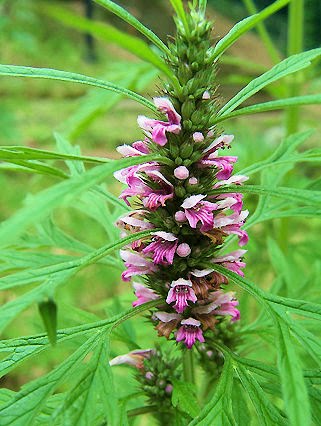
Leonurus sibiricus "Marijuanilla"

Leonurus sibiricus
Leonurus sibiricus "Marijuanilla"


Family: Lamiaceae

Genus: Leonurus
Species: sibiricus

Category: Perennials

Height:
4-6 ft. (1.2-1.8 m)

Spacing: 24-36 in. (60-90 cm)

Hardiness:
USDA Zone 5a: to -28.8 °C (-20 °F)
USDA Zone 5b: to -26.1 °C (-15 °F)
USDA Zone 6a: to -23.3 °C (-10 °F)
USDA Zone 6b: to -20.5 °C (-5 °F)USDA Zone 7a: to -17.7 °C (0 °F)
USDA Zone 7b: to -14.9 °C (5 °F)
USDA Zone 8a: to -12.2 °C (10 °F)
USDA Zone 8b: to -9.4 °C (15 °F)
USDA Zone 9a: to -6.6 °C (20 °F)
USDA Zone 9b: to -3.8 °C (25 °F)


Sun Exposure: Full Sun

Bloom Color: Pink


Description
Leonurus sibiricus is an herbaceous annual or biennial with upright stems that grow from 20 to 80 cm tall. Plants have long petioled basal leaves that are ovate-cordate in shape. The leaves have toothed margins and are incised with deeply cut lobes. Typically one or a few flowering stems are produced from short tap-roots. The lower stem leaves are deciduous and wither away as the plants begin blooming. The petioles of the leaves, midway up the stems are 2 cm long. The flowers are produced in many flowered verticillasters, produced in whorls around the top half or more of the stem. The flowers are sessile with 8 mm long calyx's that are tubular-campanulate in shape. The corolla is white or reddish to purple-red, with an upper lip that is oblong in shape and longer than the lower lip. When flowering is done, brown oblong shaped nutlets are produced in good number. Blooming occurs from July into late September, but flowering can occur year round when climate permits.


Alkaloids
Leonurine is one of the active components of Leonurus sibiricus
Alkaloids isolated from the plant include:

* Cycloleonurinine
* Leoheterin
* Leonurine
* Leonurinine* Leuronurine
* Prehispanolone
* Preleoheterin
* Stachydrine


About This Item:


Item: Leonurus sibiricus- Seeds
Originating from Malaysia, this Old World plant has made its way into the New World where apparently it has come to be used as a substitute for Cannabis sativa in the Chiapas region of Mexico where they call it "marahuanilla" or the "little marijuana."

Simple to grow, these plants make attractive ornamentals with their interesting foliage and ever-blooming purple flowers. While apparently rich in alkaloids, it does not contain THC and owes its interesting entheogenic effects to a yet unidentified compound.

Medicinal Uses:
Antibacterial; Antispasmodic; Astringent; Cardiac; Depurative; Diaphoretic; Diuretic; Emmenagogue; Hypnotic; Nervine; Oxytoxic; Stimulant; Stomachic; Tonic.

Chinese motherwort is unusual amongst Chinese herbs in that it is often prescribed for use on its own and not in a mixture with other plants. The whole plant is antibacterial, antispasmodic, astringent, cardiac, depurative, diaphoretic, diuretic, emmenagogue, hypnotic, nervine, oxytocic, stomachic, tonic, uterine stimulant. The seeds have a similar action to the plant, but are a less effective diuretic and depurative. The plant is used in the treatment of painful and excessive menstruation, post-partum bleeding, oedema, kidney complaints, kidney stones, eczema and abscesses. A tincture is used in the treatment of rheumatic fever. The plant stimulates uterine contractions and should not therefore be used when in the earlier stages of pregnancy. The plant is harvested when in flower but before the seeds have set, and is dried for later use.

The plant contains about 0.05% of an alkaloid called leonurine. This has a curare-like effect on the motor-endings of the nervous system, acting in small doses as a stimulant to the respiratory system but in large doses causing respiratory paralysis.


Leonurus sibiricus "Marijuanilla"

Followers

LABEL REFERENCE