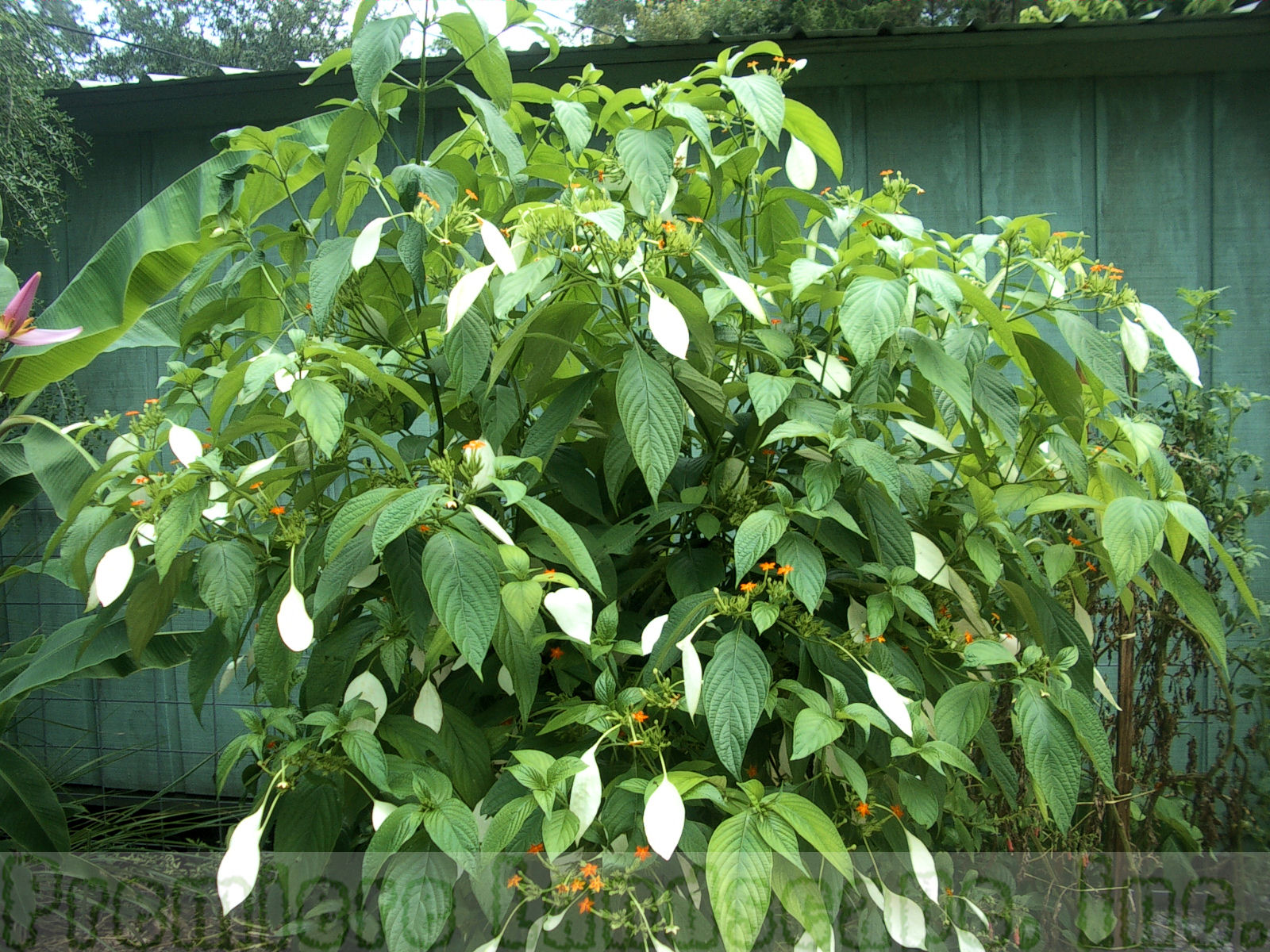
I had to show some shots of how huge the gardens are this year. The hummingbirds and butterflies are great and plentiful.
Premiere Landscape, Inc.
Showing posts with label Clerodendrum trichotomum. Show all posts
Thursday, August 15, 2013
Saturday, September 11, 2010
Clerodendrum trichotomum
Family: Verbenaceae (ver-be-NAY-see-ee)
Genus: Clerodendrum (kler-oh-DEN-drum)
Species: trichotomum (try-KOH-toh-mum)
Synonym:Clerodendron trichotomum
Synonym:Siphonanthus trichotomum
Genus: Clerodendrum (kler-oh-DEN-drum)
Species: trichotomum (try-KOH-toh-mum)
Synonym:Clerodendron trichotomum
Synonym:Siphonanthus trichotomum

Category:
Shrubs
Trees
Height:
15-20 ft. (4.7-6 m)
Spacing:
15-20 ft. (4.7-6 m)
Hardiness:
USDA Zone 6a: to -23.3 °C (-10 °F)
USDA Zone 6b: to -20.5 °C (-5 °F)
USDA Zone 7a: to -17.7 °C (0 °F)
USDA Zone 7b: to -14.9 °C (5 °F)
USDA Zone 8a: to -12.2 °C (10 °F)
USDA Zone 8b: to -9.4 °C (15 °F)
USDA Zone 9a: to -6.6 °C (20 °F)
USDA Zone 9b: to -3.8 °C (25 °F)
Sun Exposure:
Sun to Partial Shade
Danger:
Seed is poisonous if ingested
Parts of plant are poisonous if ingested
Handling plant may cause skin irritation or allergic reaction
Bloom Color:
Pink
Red
White/Near White
Bloom Time:
Mid Summer
Late Summer/Early Fall
Foliage:
Deciduous
Aromatic
Other details:
Flowers are fragrant
Average Water Needs; Water regularly; do not overwater
Soil pH requirements:
4.6 to 5.0 (highly acidic)
5.1 to 5.5 (strongly acidic)
5.6 to 6.0 (acidic)
6.1 to 6.5 (mildly acidic)
6.6 to 7.5 (neutral)
Propagation Methods:
By dividing the rootball
From softwood cuttings
From semi-hardwood cuttings
From seed; direct sow after last frost
From root stolons
(Stoloniferous-Producing stolons.)
Shrubs
Trees
Height:
15-20 ft. (4.7-6 m)
Spacing:
15-20 ft. (4.7-6 m)
Hardiness:
USDA Zone 6a: to -23.3 °C (-10 °F)
USDA Zone 6b: to -20.5 °C (-5 °F)
USDA Zone 7a: to -17.7 °C (0 °F)
USDA Zone 7b: to -14.9 °C (5 °F)
USDA Zone 8a: to -12.2 °C (10 °F)
USDA Zone 8b: to -9.4 °C (15 °F)
USDA Zone 9a: to -6.6 °C (20 °F)
USDA Zone 9b: to -3.8 °C (25 °F)
Sun Exposure:
Sun to Partial Shade
Danger:
Seed is poisonous if ingested
Parts of plant are poisonous if ingested
Handling plant may cause skin irritation or allergic reaction
Bloom Color:
Pink
Red
White/Near White
Bloom Time:
Mid Summer
Late Summer/Early Fall
Foliage:
Deciduous
Aromatic
Other details:
Flowers are fragrant
Average Water Needs; Water regularly; do not overwater
Soil pH requirements:
4.6 to 5.0 (highly acidic)
5.1 to 5.5 (strongly acidic)
5.6 to 6.0 (acidic)
6.1 to 6.5 (mildly acidic)
6.6 to 7.5 (neutral)
Propagation Methods:
By dividing the rootball
From softwood cuttings
From semi-hardwood cuttings
From seed; direct sow after last frost
From root stolons
(Stoloniferous-Producing stolons.)
General Culture:
Winter hardy to USDA Zones 7-10 where it is grown in organically rich, well-drained soils in full sun to part shade. In St. Louis, it is not reliably winter hardy and, if attempted, should be sited in a protected location with a winter mulch.
Noteworthy Characteristics:
Native to China and Japan, this clerodendrum is a coarse, sometimes unkempt, deciduous shrub or small tree that grows 10-20’ tall. It is most often seen as a suckering shrub. It must be trained to grow as a tree and is rarely seen growing in that form. As an ornamental, this shrub is perhaps best noted for its late summer flowers, showy fruit and malodorous foliage. Tubular, fragrant, white flowers in long-peduncled cymes (to 6-9” across) bloom in the upper leaf axils from late summer into fall. Flowers are followed by small bright blue fruits, each subtended by a fleshy red calyx. Opposite, toothed to entire, ovate, dark green leaves (to 5-8” long) produce no fall color. When bruised, the leaves do produce a unique aroma reminiscent of peanut butter as memorialized by the sometimes used common name of peanut butter tree for this plant. Harlequin glorybower is a more frequently used common name. Clerodendrum comes from the Greek words klero (fate) and dendron (tree), hence the infrequently used common name of fate tree.
Problems:
No serious insect or disease problems.
Uses:
Where winter hardy, grow in shrub borders or woodland margins.
Clerodendron trichotomum is also known as harlequin glorybower. This vigorous shrub or small tree is native to China and Japan, and a spreading shape. It often has multiple trunks. Young twigs are hairy. Leaves appear relatively late, and fall with first frosts.
This tree is ornamental and frost hardy : mature trees can withstand USDA zones 6 frosts.
Winter hardy to USDA Zones 7-10 where it is grown in organically rich, well-drained soils in full sun to part shade. In St. Louis, it is not reliably winter hardy and, if attempted, should be sited in a protected location with a winter mulch.
Noteworthy Characteristics:
Native to China and Japan, this clerodendrum is a coarse, sometimes unkempt, deciduous shrub or small tree that grows 10-20’ tall. It is most often seen as a suckering shrub. It must be trained to grow as a tree and is rarely seen growing in that form. As an ornamental, this shrub is perhaps best noted for its late summer flowers, showy fruit and malodorous foliage. Tubular, fragrant, white flowers in long-peduncled cymes (to 6-9” across) bloom in the upper leaf axils from late summer into fall. Flowers are followed by small bright blue fruits, each subtended by a fleshy red calyx. Opposite, toothed to entire, ovate, dark green leaves (to 5-8” long) produce no fall color. When bruised, the leaves do produce a unique aroma reminiscent of peanut butter as memorialized by the sometimes used common name of peanut butter tree for this plant. Harlequin glorybower is a more frequently used common name. Clerodendrum comes from the Greek words klero (fate) and dendron (tree), hence the infrequently used common name of fate tree.
Problems:
No serious insect or disease problems.
Uses:
Where winter hardy, grow in shrub borders or woodland margins.
Clerodendron trichotomum is also known as harlequin glorybower. This vigorous shrub or small tree is native to China and Japan, and a spreading shape. It often has multiple trunks. Young twigs are hairy. Leaves appear relatively late, and fall with first frosts.
This tree is ornamental and frost hardy : mature trees can withstand USDA zones 6 frosts.

Leaves of the harlequin glorybower are deciduous, simple, entire, opposite and elliptic to ovate. They are about 7-10 in (17-25 cm) long and 2-6 in (5-15 cm) wide. Leave stems can be quite long. When crushed, leaves have an unpleasant odour.
Flowers are white, tubular, red and white, with 4 prominent stamens. They are strongly scented, and grouped in terminal panicles of 6-8 in (15-20 cm) in diameter. Flowers appear on new wood, in mid to late summer.
The fruits are inedible, fleshy and globose, less than 0.5 in (1.25 cm) in diameter, and are bright blue when ripe.
Kingdom Plantae – Plants
Subkingdom Tracheobionta – Vascular plants
Superdivision Spermatophyta – Seed plants
Division Magnoliophyta – Flowering plants
Class Magnoliopsida – Dicotyledons
Subclass Asteridae
Order Lamiales
Family Verbenaceae – Verbena family
Genus Clerodendrum L. – glorybower
Species Clerodendrum trichotomum Thunb. – harlequin glorybower

Subscribe to:
Posts (Atom)
Followers
LABEL REFERENCE
- Abelia (1)
- Abelia plants (1)
- Abita (1)
- Abita landscapes (2)
- Abita River (1)
- Abita Springs (3)
- Abita Springs Louisiana (4)
- Abita Springs-Louisiana (1)
- Abroma (1)
- Abroma augusta (1)
- Abroma augusta 'Devil's Cotton' (1)
- abutilon (3)
- Abutilon x hybridum (1)
- Agastache (1)
- Agastache aurantiaca (1)
- Agave (2)
- Agave bloom spike (1)
- agave in bloom (1)
- Agave ovatifolia (1)
- Aloe (2)
- Aloe macrocarpa (2)
- Aloysia citriodora 'Lemon Verbena' (1)
- Amaranthaceae (1)
- Annual (2)
- Aristilochia (2)
- Aristolochia (1)
- Aristolochia elegans (1)
- Bauhinia climber (1)
- Bees (1)
- Bidenomics (1)
- bird watching (1)
- bird watching in Abita Springs Louisiana (1)
- Blue flowers (2)
- Bromeliad (3)
- butterfly plant (10)
- Butterfly Vine (2)
- Caesalpinia Bauhinia (1)
- Calathea (1)
- Calathea Makoyana (1)
- Calathea Maranta (1)
- Calathea oranata (1)
- Calathea Orbifolia (1)
- Callicarpa (1)
- Callicarpa dichotoma (1)
- Callicarpa dichotoma 'Early Amethyst' (1)
- caterpillar (1)
- Cesalpinia pulcherrima (1)
- chimney swift chimney (1)
- chimney swifts (1)
- Clematis (1)
- Clerodendrum (3)
- Clerodendrum paniculatum (1)
- Clerodendrum trichotomum (2)
- Clerodendrum ugandense (1)
- Clifton estate (1)
- Clifton family (2)
- climber (1)
- color (1)
- Conservative view (1)
- conservative views (1)
- Coreopsis (1)
- Coreopsis tinctoria (1)
- Covington Louisiana (1)
- Cuphea (1)
- Cuphea llavea (1)
- Cuphea llavea Flamenco Samba (1)
- Cypress forest (1)
- Cypress trees (1)
- Datura fastuosa 'Double Purple' (1)
- Deciduous (1)
- Deciduous plants (1)
- desert garden (1)
- Dicliptera suberecta (1)
- drought tolerant plants (1)
- dry (2)
- dry garden (1)
- dry loving plants (1)
- Duranta erecta 'Alba' (1)
- Dyckia 'Silver Star' (1)
- Dyckia Platyphylla (1)
- Dyckia;Xerophytic (1)
- Echeveria (1)
- Echeveria runyonii (1)
- Echeveria runyonii var Topsy Turvy (1)
- Eranthemum (1)
- evergreen shrubs (1)
- Fern (2)
- Florida drought tolerant plants (1)
- Florida landscape (1)
- Florida landscape plants (1)
- Florida plants (1)
- flowering shrub (6)
- flowers (1)
- fragrant flowers (1)
- full sun (1)
- fuzy flowers (1)
- fuzzy leaves (1)
- garden video (1)
- Garden views (2)
- Gasteria (1)
- Gomphrena (1)
- Grasses (1)
- grey foliage (1)
- Gulf Coast Gardens (1)
- Gulf Hills (1)
- Gulf Hills Hotel (1)
- Gulf Hills Hotel & Resort (1)
- Gulf Hills Hotel and Resort (1)
- Gulf Hills Mississippi (1)
- Gulf Hills Resort (1)
- heat (1)
- heat tolerant plant (1)
- Herbaceous shrub (1)
- Heteropterys angustifolia (1)
- Hibiscus (2)
- Hibiscus coccineus (1)
- Hibiscus moscheutos (1)
- Holmskioldia (1)
- Holmskioldia tettensis (1)
- honey bees (1)
- honey production plants (1)
- hot (1)
- houseplants (1)
- Hummer Haven (4)
- HummerHaven (1)
- hummingbird flower (1)
- hummingbird plant (5)
- Hydrangea (3)
- Hydrangea arborescens 'Invincibelle Spirit' (1)
- Hydrangea macrophylla (1)
- Hydrangea paniculata (1)
- Hydrangea paniculata 'Limelight' (1)
- Indoor plant variegated plant (1)
- June flowers (1)
- Keiki (1)
- Leonurus sibiricus "Marijuanilla"; Leonurus sibiricus; perennial; (1)
- Lespedeza (1)
- Lespedeza thunbergii (1)
- Lespedeza thunbergii 'Gibraltar' (1)
- Louisiana (2)
- Louisiana economics (1)
- Louisiana flowers (1)
- Louisiana gardening (1)
- Louisiana gardens (4)
- Louisiana horticulture (1)
- Louisiana perennials (1)
- Louisiana Snow (1)
- LSU Agriculture Research Station (1)
- Malpighiaceae (1)
- Malvaviscus (1)
- Malvaviscus drummondii. Pink Pavonia (1)
- Maranta (1)
- maroon flowers (1)
- Mascagnia macroptera (1)
- Millettia taiwanensis (1)
- Mississippi (1)
- Mussaenda (2)
- Mussaenda ‘Ashanti Blood’ (1)
- nature hiking (1)
- Nature in St. Tammany Parish (2)
- nectar flower (1)
- Ocean Springs (1)
- Ocean Springs Mississippi (1)
- odontonema (1)
- Orange flowers (4)
- Orange-red (1)
- Orchid (1)
- Orchids (1)
- Orthosiphon aristatus (1)
- palm flower pollination (1)
- palm flowers (1)
- palm inflorescence (1)
- Palms (2)
- Passiflora (1)
- Passion vine (2)
- paths (1)
- Paul A. Clifton (3)
- Paul A. Clifton Horticulturalist (1)
- Paul Clifton (4)
- Pensacola Beach (1)
- Pensacola beach Florida plants (1)
- perennial (2)
- Perennials (9)
- perrineial (6)
- Petrea volubilis; vines; blue flowers (2)
- Phalaenopsis (1)
- Phalaenopsis orchids (1)
- Pink flower (5)
- Pipevine Swallowtail (1)
- Plannting Guide (1)
- Plant care (1)
- Planting rules (1)
- plants for sale (1)
- plants with pink (1)
- plants with purple (1)
- pollinators (1)
- post office (1)
- post office boxes (1)
- Premiere Landscape Inc. (2)
- Purple (4)
- purple berry (1)
- purple flower (1)
- Puya mirabilis (1)
- red and blue flowers (1)
- Red Flowers (4)
- red leaves (1)
- ROSES (1)
- Ruellia (1)
- Ruellia elegans (1)
- Sansevieria (1)
- Sansevieria Cylindrica (1)
- Sansevieria trifasciata Laurentii (1)
- shade house plant (1)
- shrub (1)
- shrubs (1)
- silver foliage (1)
- Sinningia Passion flower (1)
- Sinningia sellovii (1)
- Snow (1)
- Snow in Abita Springs (1)
- snow in Covington Louisiana 2025 (1)
- South eastern louisiana (1)
- Southern gardening (1)
- southern gardens (4)
- southern landscape (2)
- St. Tammany nature park (1)
- St. Tammany Parish (3)
- St. Tammany parish landscapes (2)
- Stefan Maronge (1)
- Stigmaphyllon ciliatum (1)
- Succulents (3)
- summer flowers (1)
- Summer plant (1)
- Summer plants (1)
- sun (1)
- sun garden (1)
- sun plant (1)
- Sunflower (1)
- Swallowtail butterfly (1)
- Taxodium distichum (1)
- Tender Perennials (2)
- tender shrub (1)
- too expensive (1)
- Trilby's restaurant (1)
- Tropicals and Tender Perennials (1)
- united states postal service (1)
- USPS (1)
- Van Spinks (1)
- video (1)
- Vine (1)
- vines (5)
- We love Trump (1)
- White flowers (5)
- woodlands (1)
- woody vines (1)
- Wynnfyrn Garden (1)
- xeriscaping (3)
- Xerophyte (1)
- xerophytic (1)
- xerophytic garden (1)
- xerophytic landscape (2)
- xerophytic plants (1)
- yellow (1)
- yellow flower (1)
- Yucca rostrata (1)
- zone 9b (1)