Search Premiere Landscape, Inc. for a plant

Dave's Garden PlantFiles search engine

Find your plant by searching PlantFiles:
-

Premiere Landscape, Inc.

Tuesday, July 20, 2010

* Botanical Name: Mussaenda erythrophylla 'Ashanti Blood'


* Family name: Rubiaceae
* Plant type: Tropical shrub or tree native to tropical West Africa.
* Light: Prefers full sun, but can tolerate semi-shade
* Moisture: Needs moderate water regularly but do not overwater. It must be watered during spells of hot and dry weather as it is not drought tolerant.
* Soil: Grow best in well-drained loamy soil.
* Propagation: From softwood or semi-hardwood cuttings, air layering and from seeds though rarely available.

Care: Mussaenda ‘Ashanti Blood’ loves hot and humid environment, so locate it where it can receive full sun to induce best flower color and continuous flowering. Prune after blooming to shape and get a bushier shrub with more branching, resulting in more flowers. It has a tendency to become straggly and leggy, so prune heavily which it can tolerate, if necessary. There are no known serious insect or disease problems but do watch for spider mites and whiteflies.


Features: An ornamental shrub or tree that can reach a height of 30 ft, though in cultivation ranges from 3 to 10 feet tall. A semi-deciduous rambling shrub with multiple stems, covered with opposite leaves that are medium to dark green, round to ovate, 3-6 inches long, pubescent and strongly veined. Macro picture of Mussaenda erythrophylla 'Ashanti Blood' (Red Flag Bush) It flowers almost non-stop through the year with several flowers borne in branching terminal panicles. Each flower is composed of a small creamish white corolla that is five-lobed (0.8 inch across), funnel-shaped with a crimson-red felt center and pubescent beneath, together with a single roundish-ovate and enlarged bright red sepal (bract) measuring 2-5 inches. It is these stunning blood red sepals that led it to be commonly named ‘Ashanti Blood’ or ‘Red Flag Bush’. This very attractive cultivar, Mussaenda erythrophylla, together with Mussaenda philippica ‘Aurorae’ are the proud parents of the horticultural hybrid, Mussaenda ‘Queen Sirikit’, that was developed in the Philippines and has gorgeous pale pink sepals and is one of the most spectacular of mussaendas.

Saturday, May 22, 2010

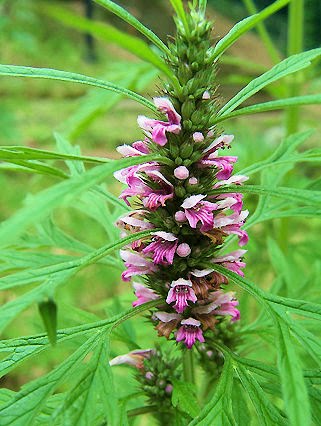
Leonurus sibiricus "Marijuanilla"

Leonurus sibiricus
Leonurus sibiricus "Marijuanilla"


Family: Lamiaceae

Genus: Leonurus
Species: sibiricus

Category: Perennials

Height:
4-6 ft. (1.2-1.8 m)

Spacing: 24-36 in. (60-90 cm)

Hardiness:
USDA Zone 5a: to -28.8 °C (-20 °F)
USDA Zone 5b: to -26.1 °C (-15 °F)
USDA Zone 6a: to -23.3 °C (-10 °F)
USDA Zone 6b: to -20.5 °C (-5 °F)USDA Zone 7a: to -17.7 °C (0 °F)
USDA Zone 7b: to -14.9 °C (5 °F)
USDA Zone 8a: to -12.2 °C (10 °F)
USDA Zone 8b: to -9.4 °C (15 °F)
USDA Zone 9a: to -6.6 °C (20 °F)
USDA Zone 9b: to -3.8 °C (25 °F)


Sun Exposure: Full Sun

Bloom Color: Pink


Description
Leonurus sibiricus is an herbaceous annual or biennial with upright stems that grow from 20 to 80 cm tall. Plants have long petioled basal leaves that are ovate-cordate in shape. The leaves have toothed margins and are incised with deeply cut lobes. Typically one or a few flowering stems are produced from short tap-roots. The lower stem leaves are deciduous and wither away as the plants begin blooming. The petioles of the leaves, midway up the stems are 2 cm long. The flowers are produced in many flowered verticillasters, produced in whorls around the top half or more of the stem. The flowers are sessile with 8 mm long calyx's that are tubular-campanulate in shape. The corolla is white or reddish to purple-red, with an upper lip that is oblong in shape and longer than the lower lip. When flowering is done, brown oblong shaped nutlets are produced in good number. Blooming occurs from July into late September, but flowering can occur year round when climate permits.


Alkaloids
Leonurine is one of the active components of Leonurus sibiricus
Alkaloids isolated from the plant include:

* Cycloleonurinine
* Leoheterin
* Leonurine
* Leonurinine* Leuronurine
* Prehispanolone
* Preleoheterin
* Stachydrine


About This Item:


Item: Leonurus sibiricus- Seeds
Originating from Malaysia, this Old World plant has made its way into the New World where apparently it has come to be used as a substitute for Cannabis sativa in the Chiapas region of Mexico where they call it "marahuanilla" or the "little marijuana."

Simple to grow, these plants make attractive ornamentals with their interesting foliage and ever-blooming purple flowers. While apparently rich in alkaloids, it does not contain THC and owes its interesting entheogenic effects to a yet unidentified compound.

Medicinal Uses:
Antibacterial; Antispasmodic; Astringent; Cardiac; Depurative; Diaphoretic; Diuretic; Emmenagogue; Hypnotic; Nervine; Oxytoxic; Stimulant; Stomachic; Tonic.

Chinese motherwort is unusual amongst Chinese herbs in that it is often prescribed for use on its own and not in a mixture with other plants. The whole plant is antibacterial, antispasmodic, astringent, cardiac, depurative, diaphoretic, diuretic, emmenagogue, hypnotic, nervine, oxytocic, stomachic, tonic, uterine stimulant. The seeds have a similar action to the plant, but are a less effective diuretic and depurative. The plant is used in the treatment of painful and excessive menstruation, post-partum bleeding, oedema, kidney complaints, kidney stones, eczema and abscesses. A tincture is used in the treatment of rheumatic fever. The plant stimulates uterine contractions and should not therefore be used when in the earlier stages of pregnancy. The plant is harvested when in flower but before the seeds have set, and is dried for later use.

The plant contains about 0.05% of an alkaloid called leonurine. This has a curare-like effect on the motor-endings of the nervous system, acting in small doses as a stimulant to the respiratory system but in large doses causing respiratory paralysis.


Leonurus sibiricus "Marijuanilla"

Thursday, April 29, 2010

DYCKIA PLATYPHYLLA

DYCKIA PLATYPHYLLA


Dyckia platyphylla

Family: Bromeliaceae
Genus: Dyckia
Species: platyphylla


Category:
Tropicals and Tender Perennials
Cactus and Succulents

Height:
6-12 in. (15-30 cm)
12-18 in. (30-45 cm)

Spacing:
18-24 in. (45-60 cm)
24-36 in. (60-90 cm)

Hardiness:
USDA Zone 9b: to -3.8 °C (25 °F)
USDA Zone 10a: to -1.1 °C (30 °F)
USDA Zone 10b: to 1.7 °C (35 °F)
USDA Zone 11: above 4.5 °C (40 °F)

Sun Exposure:
Sun to Partial Shade
Light Shade

Danger:
Plant has spines or sharp edges; use extreme caution when handling

Bloom Color:
Orange and Yellow

Bloom Time:
Mid Winter early Spring in Southern United States

Foliage:
Green to Green Gray with red edges during bloom times

Other details:
Drought-tolerant; suitable for xeriscaping

Soil pH requirements:
Dry, porous and well drained.


Propagation Methods:
Plant division by removing pups.


Thursday, February 18, 2010

PLANT CARE


Plant Care


____

Fertilizing
How-tos : Fertilization for Young Plants

Young plants need extra phosphorus to encourage good root development. Look for a fertilizer that has phosphorus, P, in it(the second number on the bag.) Apply recommended amount for plant per label directions in the soil at time of planting or at least during the first growing season.

How-tos : Fertilization for Established Plants

Established plants can benefit from fertilization. Take a visual inventory of your landscape. Trees need to be fertilized every few years. Shrubs and other plants in the landscape can be fertilized yearly. A soil test can determine existing nutrient levels in the soil. If one or more nutrients is low, a specific instead of an all-purpose fertilizer may be required. Fertilizers that are high in N, nitrogen, will promote green leafy growth. Excess nitrogen in the soil can cause excessive vegetative growth on plants at the expense of flower bud development. It is best to avoid fertilizing late in the growing season. Applications made at that time can force lush, vegetative growth that will not have a chance to harden off before the onset of cold weather.

Light
Conditions : Light and Plant Selection

For best plant performance, it is desirable to match the correct plant with the available light conditions. Right plant, right place! Plants which do not receive sufficient light may become pale in color, have fewer leaves and a "leggy" stretched-out appearance. Also expect plants to grow slower and have fewer blooms when light is less than desirable. It is possible to provide supplemental lighting for indoor plants with lamps. Plants can also receive too much light. If a shade loving plant is exposed to direct sun, it may wilt and/or cause leaves to be sunburned or otherwise damaged.

Conditions : Full Sun

Full Sun is defined as exposure to more than 6 hours of continuous, direct sun per day.

Watering
Problems : Waterlogged Soil and Solutions

Waterlogged soil occurs when more water is added to soil than can drain out in a reasonable amount of time. This can be a severe problem where water tables are high or soils are compacted. Lack of air space in waterlogged soil makes it almost impossible for soil to drain. Few plants, except for bog plants, can tolerate these conditions. Drainage must be improved if you are not satisfied with bog gardening. Over-watered plants have the same wilted leaves as under-watered plants. Fungi such as Phytophthora and Pythium affect vascular systems, which cause wilt.

If the problem is only on the surface, it maybe diverted to a drainage ditch. If drainage is poor where water table is high, install an underground drainage system. You should contact a contractor for this. If underground drains already exist, check to see if they are blocked.

French drains are another option. French drains are ditches that have been filled with gravel. It is okay to plant sod on top of them. More obtrusive, but a good solution where looks aren't as important, think of the French drain as a ditch filled with gravel. Ditches should be 3 to 4 feet deep and have sloping sides.

A soakway is a gravel filled pit where water is diverted to via underground pipes. This works well on sites that have compacted soil. Your soakway should be about 6'wide and deep and filled with gravel or crushed stone, topped with sand and sodded or seeded.

Keep in mind that it is illegal to divert water onto other people's property. If you do not feel that you can implement a workable solution on your own, call a contractor.

Tools : Watering Aides

No gardener depends 100% on natural rainfall. Even the most water conscious garden appreciates the proper hose, watering can or wand.

    Watering Cans: Whether you choose plastic of galvanized makes no difference, but do look for generous capacity and a design that is balanced when filled with water. A 2 gallon can (which holds 18 lbs. of water) is preferred by most gardeners and is best suited for outdoor use. Indoor cans should be relatively smaller with narrower spouts and roses (the filter head).
    Watering Hose: When purchasing a hose, look for one that is double-walled, as it will resist kinking. Quick coupler links are nice to have on ends of hoses to make altering length fast. To extend the life of your hose, keep it wound around a reel and stored in a shady area. Prior to winter freezes, drain hose.
    Sprayers: Are commonly thought of as devices for applying chemicals, but can really be a step saver for watering houseplants or small pots of annuals rather that dragging out a hose or making numerous trips with a watering can. The backpack sprayer is best suited for this. Take care not to use any kind of chemical in tanks used for watering!
    Sprinklers: Attached to the ends of garden hoses, these act as an economical irrigation system. Standing Spike Sprinklers are usually intended for lawns and deliver water in a circular pattern. Rotating Sprinklers deliver a circle of water and are perfect for lawns, shrubs and flower beds. Pulse-jet sprinklers cover large areas of ground in a pulsating, circular pattern. The head usually sits up on a tall stem, except for when watering lawns. Oscillating sprinklers are best for watering at ground level in a rectangular pattern.


Conditions : Regular Moisture for Outdoor Plants

Water when normal rainfall does not provide the preferred 1 inch of moisture most plants prefer. Average water is needed during the growing season, but take care not to overwater. The first two years after a plant is installed, regular watering is important. The first year is critical. It is better to water once a week and water deeply, than to water frequently for a few minutes.

Conditions : Moist and Well Drained

Moist and well drained means exactly what it sounds like. Soil is moist without being soggy because the texture of the soil allows excess moisture to drain away. Most plants like about 1 inch of water per week. Amending your soil with compost will help improve texture and water holding or draining capacity. A 3 inch layer of mulch will help to maintain soil moisture and studies have shown that mulched plants grow faster than non-mulched plants.

Conditions : Outdoor Watering

Plants are almost completely made up of water so it is important to supply them with adequate water to maintain good plant health. Not enough water and roots will wither and the plant will wilt and die. Too much water applied too frequently deprives roots of oxygen leading to plant diseases such as root and stem rots. The type of plant, plant age, light level, soil type and container size all will impact when a plant needs to be watered. Follow these tips to ensure successful watering:

* The key to watering is water deeply and less frequently. When watering, water well, i.e. provide enough water to thoroughly saturate the root ball. With in-ground plants, this means thoroughly soaking the soil until water has penetrated to a depth of 6 to 7 inches (1' being better). With container grown plants, apply enough water to allow water to flow through the drainage holes.

* Try to water plants early in the day or later in the afternoon to conserve water and cut down on plant stress. Do water early enough so that water has had a chance to dry from plant leaves prior to night fall. This is paramount if you have had fungus problems.

* Don't wait to water until plants wilt. Although some plants will recover from this, all plants will die if they wilt too much (when they reach the permanent wilting point).

* Consider water conservation methods such as drip irrigation, mulching, and xeriscaping. Drip systems which slowly drip moisture directly on the root system can be purchased at your local home and garden center. Mulches can significantly cool the root zone and conserve moisture.

* Consider adding water-saving gels to the root zone which will hold a reserve of water for the plant. These can make a world of difference especially under stressful conditions. Be certain to follow label directions for their use.


Conditions : Normal Watering for Outdoor Plants

Normal watering means that soil should be kept evenly moist and watered regularly, as conditions require. Most plants like 1 inch of water a week during the growing season, but take care not to over water. The first two years after a plant is installed, regular watering is important for establishment. The first year is critical. It is better to water once a week and water deeply, than to water frequently for a few minutes.

How-tos : Reduce Watering

This plant requires less watering during winter months, so reduce watering from late November through early March.

Planting
How-tos : Planting Vines & Climbers

Choose the planting site for your climber carefully: its long flexible stems may need some shelter, but planting right next to a wall might keep it from the sun or water it needs. Make sure that there's room for the climber to grow when it gets tall, and remember that it will grow towards the sun unless carefully trained. Be sure you will be able to manage the plant once it becomes tall, or that if it has a mind of its own, it won't become a problem.

Select a support structure before you plant your climber. Common support structures are trellises, wires, strings, or existing structures. Some plants, like ivy, climb by aerial roots and need no support. Aerial rooted climbers are fine for concrete and masonary, but should never be allowed to climb on wood. Clematis climbs by leaf stalks and the Passion flower by coiling tendrils. Akebia and Wisteria climb by twining stems in a spiral fashion around its support.

Do not use permanent ties; the plant will quickly outgrow them. Use soft, flexible ties (twist-ties work well), or even strips of pantyhose, and check them every few months. Make sure that your support structure is strong, rust-proof, and will last the life of the plant. Anchor your support structure before you plant your climber.

Dig a hole large enough for the root ball. Plant the climber at the same level it was in the container. Plant a little deeper for clematis or for grafted plants. Fill the hole with soil, firming as you, and water well. As soon as the stems are long enough to reach their support structure, gently and loosely tie them as necessary.

If planting in a container, follow the same guidelines. Plan ahead by adding a trellis to the pot, especially if the container will not be positioned where a support for the vine is not readily available. It is possible for vines and climbers to ramble on the ground or cascade over walls too. Clematis and Roses actually work quite well this way.

Problems
Miscellaneous
Conditions : Deer Tolerant

There are no plants that are 100% deer resistant, but many that are deer tolerant. There are plants that deer prefer over others. You will find that what deer will or will not eat varies in different parts of the country. A lot of it has to do with how hungry they are. Most deer will sample everything at least once, decide if they like it or not and return if favorable. A fence is the good deer barrier. You may go for a really tall one (7 to 8 feet), or try 2 parallel fences, (4 to 5 feet apart). Use a wire mesh fence rather than board, since deer are capable of wiggling through a 12 inch space.

Glossary : Sandy Loam

Sandy Loam refers to a soil that drains well, with excellent air space, and evenly crumbled texture when squeezed in the hand. A good workable garden soil that benefits from added fertilizer and proper watering. Dark gray to gray-brown in color.

Glossary : Clayey Loam

Clayey loam refers to a soil that retains moisture well, without having a drainage problem. Fertility is high and texture good. Easily forms a ball when squeezed in the hand, and then crumbles easily with a quick tap of the finger. Considered an ideal soil. Usually a rich brown color.

Glossary : Evergreen

Evergreen refers to plants that hold onto their leaves or needles for more than one growing season, shedding them over time. Some plants such as live oaks are evergreen, but commonly shed the majority of their older leaves around the end of January.

Glossary : pH

pH, means the potential of Hydrogen, is the measure of alkalinity or acidity. In horticulture, pH refers to the pH of soil. The scale measures from 0, most acid, to 14, most alkaline. Seven is neutral. Most plants prefer a range between 5.5 and about 6.7, an acid range, but there are plenty of other plants that like soil more alkaline, or above 7. A pH of 7 is where the plant can most easily absorb the most nutrients in the soil. Some plants prefer more or less of certain nutrients, and therefore do better at a certain pH.

Glossary : Fertilize

Fertilize just before new growth begins with a complete fertilizer.


Mascagnia macroptera


Mascagnia macroptera


Yellow Orchid Vine, Yellow Butterfly Vine, Gallinita


Synonym:Callaeum macroptera

Stigmaphyllon ciliatum
( Stigmaphyllon )


Family: Malpighiaceae

Genus: Mascagnia (mas-KAYN-ee-a)
Species: macroptera (mak-roh-TER-uh)


Category:
Vines and Climbers

Height:
12-15 ft. (3.6-4.7 m)

Spacing:
12-15 ft. (3.6-4.7 m)

Hardiness:
USDA Zone 9a: to -6.6 °C (20 °F)
USDA Zone 9b: to -3.8 °C (25 °F)
USDA Zone 10a: to -1.1 °C (30 °F)
USDA Zone 10b: to 1.7 °C (35 °F)

Sun Exposure:
Full Sun

Danger:
N/A

Bloom Color:
Bright Yellow

Bloom Time:
Mid Spring
Late Spring/Early Summer
Mid Summer

Foliage:
Deciduous

Other details:
Average Water Needs; Water regularly; do not overwater

Soil pH requirements:
5.6 to 6.0 (acidic)
6.1 to 6.5 (mildly acidic)
6.6 to 7.5 (neutral)
7.6 to 7.8 (mildly alkaline)

Patent Information:
Non-patented

Propagation Methods:
From seed; direct sow after last frost

Seed Collecting:
Allow pods to dry on plant; break open to collect seeds

Thursday, July 23, 2009

Aristolochia elegans


Aristolochia elegans


PlantFiles: Elegant Dutchman's Pipe, Calico Flower, Pelican Flower

Aristolochia elegans

Family: Aristolochiaceae

Genus: Aristolochia (a-ris-toh-LOH-kee-uh) (Info)

Species: elegans (ELL-eh-ganz) (Info)

Synonym: Aristolochia littoralis

Category: Tropicals and Tender Perennials

Vines and Climbers

Height:

6-8 ft. (1.8-2.4 m)

8-10 ft. (2.4-3 m)

10-12 ft. (3-3.6 m)

12-15 ft. (3.6-4.7 m)

15-20 ft. (4.7-6 m)

Spacing:36-48 in. (90-120 cm)

Hardiness:

USDA Zone 8a: to -12.2 °C (10 °F)

USDA Zone 8b: to -9.4 °C (15 °F)

USDA Zone 9a: to -6.6 °C (20 °F)

USDA Zone 9b: to -3.8 °C (25 °F)

USDA Zone 10a: to -1.1 °C (30 °F)

USDA Zone 10b: to 1.7 °C (35 °F)

Sun Exposure: Light Shade

Danger: All parts of plant are poisonous if ingested

Bloom Color: Green-Maroon (Purple-Brown)

Bloom Time:

Late Winter/Early Spring

Mid Spring

Late Spring/Early Summer

Mid Summer

Late Summer/Early Fall

Foliage: Evergreen

Other details: May be a noxious weed or invasive

This plant is attractive to bees, butterflies and/or birds

Flowers are fragrant: Smell like Lemons

Average Water Needs; Water regularly; do not over water

Soil pH requirements: 6.6 to 7.5 (neutral)

Propagation Methods: From herbaceous stem cuttings

Seed Collecting: Collect seed head/pod when flowers fade; allow to dry


Cesalpinia pulcherrima


Cesalpinia pulcherrima


Caesalpinia pulcherrima


PlantFiles: Pride of Barbados, Red Bird of Paradise, Dwarf Poinciana, Peacock Flower, flamboyan-de-jardin
.

Caesalpinia pulcherrima

Family: Caesalpiniaceae
Genus: Caesalpinia (ses-al-PIN-ee-uh)

Species: pulcherrima (pul-KAIR-ih-muh) (Info) Synonym:Poinciana pulcherrima .

Category:
Shrubs Tropicals and Tender Perennials Height: 4-6 ft. (1.2-1.8 m) 6-8 ft. (1.8-2.4 m)
Spacing:
4-6 ft. (1.2-1.8 m)
Hardiness:
USDA Zone 8a: to -12.2 °C (10 °F)
USDA Zone 8b: to -9.4 °C (15 °F)

USDA Zone 9a: to -6.6 °C (20 °F)
USDA Zone 9b: to -3.8 °C (25 °F)
USDA Zone 10a: to -1.1 °C (30 °F)
USDA Zone 10b: to 1.7 °C (35 °F)
USDA Zone 11: above 4.5 °C (40 °F)

Sun Exposure: Sun to Partial Shade
Danger: Seed is poisonous if ingested. Parts of plant are poisonous if ingested.

Bloom Color: Red Bright Yellow
Bloom Time: Late Summer/Early Fall Mid Fall Blooms all year

Foliage: Deciduous

Other details: This plant is attractive to bees, butterflies and/or birds

Average Water Needs; Water regularly; do not overwater

Self-sows freely; deadhead if you do not want volunteer seedlings next season

Soil pH requirements: 5.6 to 6.0 (acidic) 6.1 to 6.5 (mildly acidic) 6.6 to 7.5 (neutral) 7.6 to 7.8 (mildly alkaline)

Propagation Methods: From seed; direct sow after last frost

Seed Collecting: Bag seedheads to capture ripening seed

Allow pods to dry on plant; break open to collect seeds

Followers

LABEL REFERENCE